2026-03-26
Diagnosing infection by breathing: the promise of breath tests
Pneumonology
By Elodie Vaz | Published on March 26, 2026 | 4 min read
Infectious diseases remain one of the leading causes of mortality worldwide. In this context, the rapid identification of bacterial infections is a critical challenge, especially as rising antimicrobial resistance requires early and targeted therapeutic decisions. However, current diagnostic tools—such as blood tests, imaging, microbiological cultures, or molecular diagnostics—are limited by delays, cost, or lack of specificity.
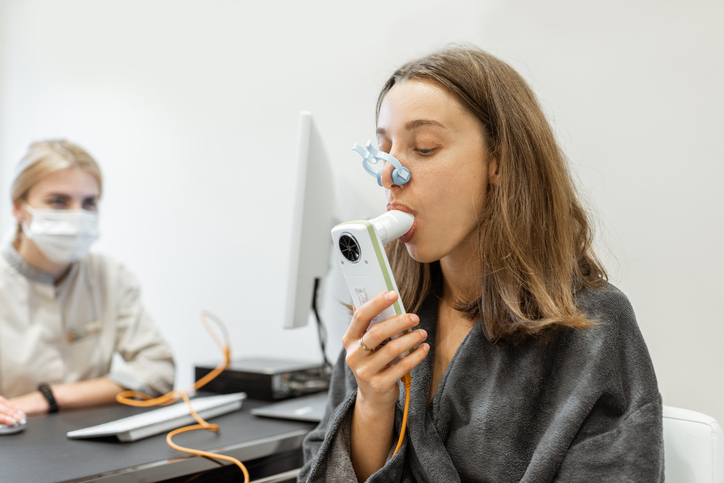
A study published on March 18 in ACS Central Science proposes an innovative alternative: breath tests capable of detecting bacterial infections within minutes. The goal is to extend and generalize the principle already used for diagnosing Helicobacter pylori, adapting it to a broader range of pathogens.
As Professor David Wilson, co-author of the study, explained in a press release: “In designing this study, we were motivated by an emerging trend in clinical practice: patients and healthcare providers want rapid answers to guide treatment decisions.” He added: “If a patient presents to the emergency department or an acute care setting, we hope that a diagnosis of acute bacterial infection can be made as quickly as possible.”
Researchers developed a prototype based on the administration of carbon-13–labeled substrates, including sugars and polyols. These compounds have a key property: they are metabolized by bacteria but largely ignored by human cells.
After administration, bacteria convert these substrates into labeled carbon dioxide, which can be detected in exhaled breath. Several compounds capable of generating this signal were identified in laboratory settings. The signal is then measured using nondispersive infrared spectroscopy, a simple technique potentially compatible with portable devices.
Experiments conducted in mice yielded promising results. In animals with pneumonia or infections of the blood, muscles, or bones, administration of labeled compounds led to a rapid increase in labeled carbon dioxide in breath. This signal typically appeared within the first ten minutes after injection.
In contrast, healthy mice showed very low or undetectable levels of carbon-13 in exhaled air. This clear difference suggests strong discriminatory power between infectious and non-infectious states.
The study also highlights potential for therapeutic monitoring. In a model of Escherichia coli infection, the amount of labeled carbon dioxide decreased during antibiotic treatment, in parallel with reductions in bacterial load.
Beyond diagnostic speed, this approach offers several advantages: it is non-invasive, relies on compounds considered safe, and could be deployed via portable devices. These features make it a strong candidate for use in emergency medicine or outpatient care. Although the protocol still requires optimization and results must be confirmed in humans, this proof of concept suggests a major shift in the management of bacterial infections.
By enabling near-immediate detection and potentially real-time monitoring of treatment efficacy, breath tests could transform clinical practice. They would address the growing need for rapid diagnostics in the context of antimicrobial resistance.
In the long term, this technology could support a more responsive and personalized form of medicine, where a simple breath test is sufficient to guide therapeutic decisions. If confirmed, this approach could fundamentally redefine diagnostic strategies for infectious diseases.
About the Author – Elodie Vaz
Health journalist, CFPJ graduate (2023).
Élodie explores the marks diseases leave on bodies and, more broadly, on human life. A registered nurse since 2010, she spent twelve years at patients’ bedsides before exchanging her stethoscope for a notebook. She now investigates the links between environment and health, convinced that the vitality of life cannot be reduced to that of humans alone.
Infectious diseases remain one of the leading causes of mortality worldwide. In this context, the rapid identification of bacterial infections is a critical challenge, especially as rising antimicrobial resistance requires early and targeted therapeutic decisions. However, current diagnostic tools—such as blood tests, imaging, microbiological cultures, or molecular diagnostics—are limited by delays, cost, or lack of specificity.
Toward immediate, non-invasive diagnosis
A study published on March 18 in ACS Central Science proposes an innovative alternative: breath tests capable of detecting bacterial infections within minutes. The goal is to extend and generalize the principle already used for diagnosing Helicobacter pylori, adapting it to a broader range of pathogens.
As Professor David Wilson, co-author of the study, explained in a press release: “In designing this study, we were motivated by an emerging trend in clinical practice: patients and healthcare providers want rapid answers to guide treatment decisions.” He added: “If a patient presents to the emergency department or an acute care setting, we hope that a diagnosis of acute bacterial infection can be made as quickly as possible.”
A metabolic approach based on carbon-13
Researchers developed a prototype based on the administration of carbon-13–labeled substrates, including sugars and polyols. These compounds have a key property: they are metabolized by bacteria but largely ignored by human cells.
After administration, bacteria convert these substrates into labeled carbon dioxide, which can be detected in exhaled breath. Several compounds capable of generating this signal were identified in laboratory settings. The signal is then measured using nondispersive infrared spectroscopy, a simple technique potentially compatible with portable devices.
Rapid and discriminatory results in animal models
Experiments conducted in mice yielded promising results. In animals with pneumonia or infections of the blood, muscles, or bones, administration of labeled compounds led to a rapid increase in labeled carbon dioxide in breath. This signal typically appeared within the first ten minutes after injection.
In contrast, healthy mice showed very low or undetectable levels of carbon-13 in exhaled air. This clear difference suggests strong discriminatory power between infectious and non-infectious states.
The study also highlights potential for therapeutic monitoring. In a model of Escherichia coli infection, the amount of labeled carbon dioxide decreased during antibiotic treatment, in parallel with reductions in bacterial load.
A technology with multiple clinical applications
Beyond diagnostic speed, this approach offers several advantages: it is non-invasive, relies on compounds considered safe, and could be deployed via portable devices. These features make it a strong candidate for use in emergency medicine or outpatient care. Although the protocol still requires optimization and results must be confirmed in humans, this proof of concept suggests a major shift in the management of bacterial infections.
A new era for infection diagnosis?
By enabling near-immediate detection and potentially real-time monitoring of treatment efficacy, breath tests could transform clinical practice. They would address the growing need for rapid diagnostics in the context of antimicrobial resistance.
In the long term, this technology could support a more responsive and personalized form of medicine, where a simple breath test is sufficient to guide therapeutic decisions. If confirmed, this approach could fundamentally redefine diagnostic strategies for infectious diseases.
Read next: Allergies and respiratory infections: toward a universal respiratory vaccine?
About the Author – Elodie Vaz
Health journalist, CFPJ graduate (2023).
Élodie explores the marks diseases leave on bodies and, more broadly, on human life. A registered nurse since 2010, she spent twelve years at patients’ bedsides before exchanging her stethoscope for a notebook. She now investigates the links between environment and health, convinced that the vitality of life cannot be reduced to that of humans alone.
Last press reviews
Does Nicotinamide Really Prevent Skin Cancer?

By Ana Espino | Published on July 01, 2026 | 4 min read<br><br><br>
Exercising in Extreme Heat: How Can Performance Be Preserved While Reducing Health Risks?

By Ana Espino | Published on June 29, 2026 | 4 min read<br><br><br>
Oropouche Virus: A New Threat to Monitor During Pregnancy?

By Ana Espino | Published on June 26, 2026 | 4 min read<br><br>